|
 |
 |
 |
 |
 |
 |
 |
 |
 |
|
|||
|
|
|||
|
Product Showcase |



Finding Out What You Don't Know You Don't Know
What gets most early-stage companies in trouble is the areas that they just don't understand that they don't know enough about. In other words the biggest problem is that they don't know what they don't know. Nearly every failed company will say they ran out of cash, couldn't raise enough capital, or just did not get the sales they expected quickly enough. But these situations are generally the effect, not the cause. Generally speaking, other problems that the company or entrepreneur does not understand very well are usually the root cause. This situation is actually far more dangerous than just not knowing, because you cannot tackle a problem that you do not even know exists. The best entrepreneurs and CEOs are learning machines and understand what they do not know. I call this the Prudent CEO or person that appreciates the fact that the last Renaissance man, or woman, existed hundreds of years ago. In this day and age, there is just way too much information that one needs to know in order to start any company without getting lots of help from others. Today, knowledge is doubling every eighteen months. Far more information is generated each year now than in the entire first thousand years of civilized society.
Would you decide to install your own furnace or rebuild your own car engine without having the proper experience? Of course not! Then why do people think they can write their own business plan, marketing plan, or design a new business model, which is a much more complex and experience- based process, when they have never done these before either? I suspect that the reason is that rebuilding an engine is physical and it will clearly provide immediate feedback of failure and probably cause confusion. However, tasks like writing a business plan will not fail for quite some time, maybe months, or even years. Of course the blind optimism of any entrepreneur, who has to be a little nuts to go against the odds anyway, is a big factor here too. So you have to ask yourself Have I done this exact task before successfully? If the answer is no, then at a minimum, you need a model to even do the job, and a guide, or coach to do a good job.
Typically, any new company will need at least four to five different skill sets at the executive level to be successful. Then you need those same skills sets at the actual execution level, and possibly even the management level too. Rarely does it make sense to hire all those people full-time on day one while you are still in a business model design and validation process. Yet without these people, you really cannot possibly know what you do not know. Most often it does not make sense to have all these needed people on full-time staff during the first one or two years of running the business. Yet you can really not expect to compete effectively with others in the marketplace without all these skill sets on your team. Although it seems like a catch-22 of sorts, there are ways around this dilemma. This is why designing a new business model must be an iterative process, as team members who are added later add more input.
Typically you should be using virtual team members and consultants in small doses to fill in these holes and identify areas that can be improved dramatically. People often look at this as a cost, which it is short term, but over even three to six months these things ought to be a net savings if you are using the right startup oriented people. You do have to watch out for consultants who want to "do it right," when right is how a multi-million or even multi-billion dollar company would do it. I would guess only one in ten consultants and professional services people out there really understand how to work with a startup. Working in startup mode means being in the risk business and developing 80% solutions at 20% of the cost because things change too fast to do it right.
So how do you figure out what you don't know without all these experts on your team? In reality, there are only a few ways to ferret out what you don't know and they are all either the result of leveraging someone else's experience or based on your own systematic research. Since research involves lots of trial and error, it is way too expensive for a startup to research what it can just learn from someone else. Researching too much can even kill a company with very little time and cash. You need some trial and error for sure, but this should only be around your core value added and new business model ideas. If someone has done it before, it is always cheaper to learn from him or her, than it is to figure it out on your own. Models built on someone else's mistakes are by far a superior alternative and come in several forms.
On Figuring Out What You Don�t Know With Models
One of the best ways to leverage other people's experience is through the use of models, or roadmaps, that have been proven to work before by others. This is because they connect the dots in an orderly fashion to insure that the proper order and priorities are mapped out. For example if you are starting a company and you don't know which corporate structure to use, would you guess, spend weeks studying all the options, or have a discussion with an expert in that area for an hour? Obviously a meeting with your attorney is in order.
In business, the most valuable models are complete step-by-step roadmaps that combine a visual diagram with a checklist or a more elaborate description to define the visual diagram in more detail. This is because human beings think about and communicate complex abstract concepts best visually. I often think a good model can sometimes even provide more useful information than an entire book because it is a more pragmatic. Visual diagrams also help people communicate because they can describe things at the highest level (the whole diagram) and also be used to point to various levels within the model to focus and remove ambiguity in communications. It is now possible to go up or down levels, or naming each level without people disconnecting. I have seen very smart people talking for long periods of time about different things without even knowing it because they did not have a reference like this and were actually talking about different levels. Only when a diagram was placed on the white board did they really connect and understand how bad their previous communications were. They went on and on without knowing because the English language is just not that exact when discussing complex concepts on many levels without specific definitions for the exact situation.
DIAGRAM OF THE OSI MODEL WHICH ENABLES COMPLEX TELECOMMUNICATIONS
|
|
Application |
|
Application |
|
|
Presentation |
|
Presentation |
||
|
Session |
|
Session |
||
|
Transport |
|
Transport |
||
|
Network |
|
Network |
||
|
Data Link |
|
Data Link |
||
|
Physical |
|
Physical |


Describing this concept in pure text would be much more difficult than this simple diagram and would be very difficult to communicate effectively. That text would also not be a very useful tool for discussing the concepts with other people.
I would venture to say that without the simple OSI model of communications above, we could literally be decades behind where we are today with telecommunications technology. Would the Internet be what it is today if the industry did not align and standardize its thinking and resources around this simple seven layer model? Not a chance. We would have massive number of competing proprietary systems and few computers would communicate without great difficulty and applications specific software. This simple model not only allowed communications between the design engineers, but it set a standard that allowed different companies to attack different levels of the problem. Breaking this huge problem down into layers actually was a huge step in accelerating an industry to a new level. Languages need visual aids to remove ambiguity whenever you are talking about multi-dimensional things. Good models are simple enough to understand and yet complete enough to be sure you are not leaving things out. Generally, due to the human mind's limitation on short-term memory, models should be divided into no more than seven to nine layers. If you need more than that, you probably need to break the problem down or process up into multiple models or diagrams.
A Model For Marketing
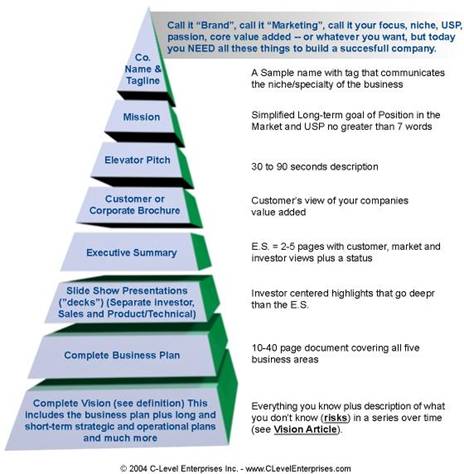
For example, the Marketing and Communications Pyramid below is really a very simple model, but it provides anyone with all the key high-level steps to figure out where they may need outside help and advice. If they understand this model very well, and have done all these steps successfully before, then they are in good shape. If they have not, they should be looking for ways to minimize the risk and learning curve with help from people who have experience with all these things. This will not only produce a better result but will also get it done faster and cheaper in the longer run.
Of course there will always be unknowns in anything worth doing and no model will have all the answers. However, a good model is a roadmap that can allow someone without enough experience to figure out what they don't know and get help where needed. As Einstein once said: If the idea at first is not absurd, then there is no hope for it. This is largely true on several levels and very profound in the context of any new idea or company. First, if it was that obvious then people would have done it before you ever got there. Second, for it to really be a new and revolutionary idea it must be radically different in some way, so as to shift the paradigm and look at the problem from a whole different perspective. So any great idea will surely be ridiculed by most before it can succeed, just like Galileo was ridiculed by his fellow scientists and the church even though he had already proven the sun could not possibly revolve around the earth.
After 16 years as a CEO, I would never begin to think I could launch a real company without significant help and input from several other people. It amazes me that some people believe they know everything they need to know to launch a business and be successful. I have never met, and don't think I ever will meet, anyone who really does know everything needed to start a sophisticated business all alone. They might know enough at a single level, or in a single vertical discipline, but certainly not across all disciplines and levels. Most entrepreneurs know there is real value in the problem they can solve for customers. If they don't, they won't be around very long. However, nobody ever knows everything they needed to know when setting out to start a new business. After all, even the Lone Ranger had help from Tonto. I read about fifty books per year and also try to attend at least four seminars a year for personal improvement to stretch my own knowledge into new areas. This need to improve and constantly update, add and replace obsolete information will never end and I KNOW I will always need help to accomplish any significant challenge in business.
So the bottom line is to look for models that have been developed by people who have already done exactly what you want to accomplish. So find a model from someone who has done it before and get a little help from the person who built the model or has ten or fifteen years experience in that discipline. Even if their model is flawed, it will be a great improvement over doing your own trial and error along the way. You will still most likely make 80% fewer errors which otherwise could cost you enormous extra time and money.
 |
 |
 |
|
|
Essential Resources For CEOs and Entrepreneurs |
 |
 |
 |
 |